When moving abroad for work, study, or long-term residence, one of the first questions for many expatriates is: “How can my family join me?” This is where Spouse Visas and Dependent Visas become essential. Both allow family members to accompany the primary visa holder, but they serve slightly different purposes and come with different rules.
In this blog, we’ll break down what Spouse and Dependent Visas are, who qualifies for each, how to apply, and the main differences between them—so you can ensure your family’s move is smooth and hassle-free
A Spouse Visa is a residency permit that allows a legally married partner to join their husband or wife who is living, working, or studying in a foreign country. This visa is specifically designed for married couples and is widely available in countries such as the UAE, the US, UK, Canada, and Australia.
Purpose of a Spouse Visa:
To allow married partners to live together in the host country.
To enable the spouse to work, study, or access local services depending on the country’s regulations.
To maintain family unity while complying with immigration laws.
A Dependent Visa is a type of visa that allows the immediate family members of a primary visa holder—typically spouses, children, and occasionally parents—to live in the same country. This visa is tied to the status of the main visa holder, who may be in the country for work, study, or long-term residency.
Purpose of a Dependent Visa:
To allow families to stay together while one member works, studies, or resides abroad.
To grant access to essential services such as healthcare, schooling, and social benefits for family members.
In some countries, dependents may also be permitted to work or study under specific conditions.
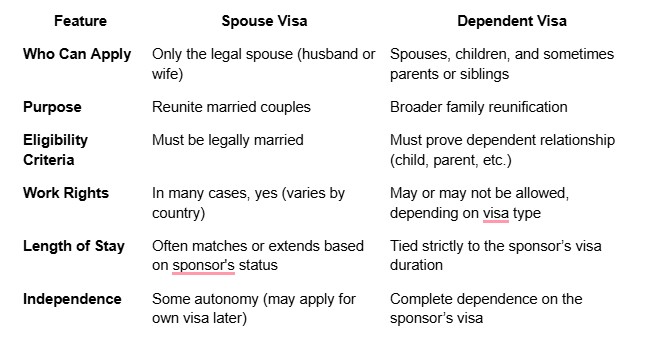
Eligibility
Spouse Visa: Only available to legally married partners.
Dependent Visa: Covers a wider range of immediate family members, including spouse, children, and sometimes parents.
Purpose
Spouse Visa: Specifically designed to reunite married couples and support family life.
Dependent Visa: Intended to keep the family unit together, often including education and healthcare access for dependents.
Work and Study Rights
Spouse Visa: Many countries allow spouses to work or study, depending on local immigration rules.
Dependent Visa: Work or study permissions vary and may require additional approvals.
Validity and Sponsorship
Spouse Visa: Typically linked to the visa of the sponsoring spouse and may have a longer validity in some countries.
Dependent Visa: Always tied to the primary visa holder’s status; validity depends on the main visa duration.
Documentation Required
Spouse Visa: Marriage certificate and proof of legal marriage.
Dependent Visa: Birth certificates for children, marriage certificate for spouse, and sometimes proof of dependency for parents.
This distinction helps applicants understand which visa suits their family situation and ensures compliance with immigration laws.
While specific requirements vary by country, most spouse visa applications require the following:
Legal Marriage: Applicants must provide proof of a legally recognized marriage with the sponsoring spouse.
Genuine Relationship: Evidence of a genuine and ongoing relationship, such as joint bank accounts, photos, communication records, or shared property.
Financial Stability: The sponsor must demonstrate sufficient income or savings to support the spouse without relying on public funds.
Health and Character Checks: Applicants may need to undergo medical examinations and criminal background checks.
Language or Integration Requirements: Some countries require basic proficiency in the local language or evidence of cultural integration.
Examples by Country:
UK: Sponsors must meet a minimum income threshold to support the spouse.
USA: Sponsors must sign an affidavit of support to guarantee financial responsibility.
UAE: Sponsors must earn a minimum monthly salary to be eligible to bring their spouse.
These criteria ensure that the visa supports family unity while meeting the host country’s legal and financial standards.
Dependent visas allow family members of the primary visa holder—such as spouses, children, or sometimes parents—to reside in the host country. Typical requirements include:
Proof of Relationship: Marriage certificate for spouses, birth certificate for children, or other legal documents confirming family ties.
Financial Support: Evidence that the primary visa holder can support dependents, usually through salary certificates, employment contracts, or bank statements.
Health Insurance: Dependents may need valid medical insurance covering their stay.
Identification Documents: Copies of passports, recent photographs, and any other required identification.
Examples by Country:
Australia: Dependents of work visa holders can study without needing a separate student visa.
Canada: Dependents may be eligible to work or study, depending on the type of primary visa held.
These criteria ensure that dependents are legally supported and integrated while residing abroad with the primary visa holder.
A Dependent Visa allows family members of the primary visa holder—typically spouses, children, and sometimes parents—to live in the host country legally. The visa is tied to the status of the primary holder and ensures that families can stay together while complying with immigration laws.
Common Requirements:
Proof of Relationship: Legal documents such as marriage certificates, birth certificates, or adoption papers.
Financial Stability: Documentation showing that the primary visa holder can provide for their dependents, such as pay slips, employment contracts, or bank statements.
Medical Coverage: Valid health insurance for each dependent may be required.
Identification: Passport copies, recent photographs, and any other documents requested by immigration authorities.
Country-Specific Examples:
Australia: Dependents of work visa holders can enroll in education without obtaining a separate student visa.
Canada: Dependents may be allowed to work or study after receiving approval linked to the primary visa.
These requirements ensure that dependents are properly supported, can access essential services, and are legally recognized while living abroad with the primary visa holder.
The process for obtaining a dependent visa generally involves the following steps:
Collect Required Documents
Proof of relationship (marriage certificate for spouse, birth certificate for children, etc.)
Copies of the primary visa holder’s passport and visa
Sponsor’s employment or study verification letters
Passport-sized photographs and identification documents
Submit the Application
Applications can often be submitted online via the immigration portal or through the respective embassy/visa application center.
Medical and Background Checks
Certain countries require medical examinations for children, elderly dependents, or long-term stays.
Police clearance or background checks may also be required depending on local regulations.
Visa Processing and Approval
Processing timelines vary by country and type of visa.
Once approved, the dependent visa allows the family member to reside legally in the host country, usually for the same duration as the primary visa holder.
This structured approach ensures dependents are legally recognized and can access services such as healthcare, education, and in some cases, employment.
Spouse Visa Holders: In many countries, spouses can work once they obtain the relevant work authorization or open work permit. For example:
Canada: Spouses on an open work permit can work for any employer.
UK: Spouses of skilled visa holders can work full-time or part-time without restrictions.
Australia: Eligible spouses can work during the validity of their partner’s visa.
Dependent Visa Holders: Work rights vary depending on the country and type of dependent visa:
USA (H-4 dependents): Work authorization is limited and requires filing for an Employment Authorization Document (EAD).
Australia & Canada: Dependents often have the right to work or study without additional applications.
UAE: Dependents can work only after securing a separate work permit from a sponsoring employer.
Tip: Always verify the host country’s immigration rules before assuming employment eligibility, as restrictions can vary widely.
Most countries require the primary visa holder to demonstrate sufficient financial capacity to support their spouse or dependents. This ensures that the family will not rely on public funds during their stay.
Commonly Required Documents:
Salary Certificate: Shows the sponsor’s current earnings.
Bank Statements: Demonstrates available savings or financial stability.
Employment Contract: Confirms ongoing employment and salary.
Proof of Accommodation: Confirms that the family has suitable living arrangements.
Note: Failing to provide adequate proof of financial support can lead to delays or denial of the visa application. Always check the specific financial thresholds set by the host country.
Applying for spouse or dependent visas can sometimes be complex. Here are the frequent hurdles applicants face:
Incomplete or Incorrect Documents: Missing certificates, unclear translations, or outdated forms can lead to delays or rejections.
Financial Requirements: Failing to meet the minimum income or financial proof criteria can block approval.
Verifying Relationship Authenticity: Authorities often scrutinize marriages and family relationships to prevent fraud.
Work and Study Limitations: Dependents may face restrictions on employment or education until additional permits are obtained.
Solution: Seeking guidance from an experienced immigration consultant or legal expert can simplify the process, ensure compliance, and reduce the risk of application denial.
When planning to bring your family abroad, selecting the right visa is crucial. A Spouse Visa is designed specifically for legally married partners, allowing them to join their spouse in a foreign country and, in many cases, providing rights to work or study depending on the local regulations. On the other hand, a Dependent Visa is intended for children, parents, or other eligible family members, enabling them to live with the primary visa holder while their rights, such as work or study, vary based on the host country’s rules.
Both visa types focus on keeping families together but differ in eligibility requirements, legal rights, and obligations. Navigating these differences can be complex, which is why professional guidance is often essential.
Amercenterdubai offers comprehensive support throughout the application process, ensuring that your documents are correctly prepared, eligibility criteria are met, and applications are submitted smoothly. Whether you are bringing a spouse, children, or other dependents, Amercenterdubai helps make the transition seamless, allowing your family to settle comfortably and legally in the new country. Moving abroad is a major life decision, and with the right visa support, you can ensure that your loved ones are part of this journey without unnecessary stress or delays.
amercentredubai is a professional virtual service provider offering UAE visa, residency, business setup, and government services through a fast, reliable, and digital-first approach.
